Netflix used to have a charmed life.
This year, however, poorly thought out strategy and lurching decisions are stripping away many of its advantages and making it vulnerable to competitors.
Established in 1997, its founders saw opportunities in creating an Internet-based DVD-by-mail distribution system. It was designed to be a competitor to physical video stores, making it more attractive by offering a larger selection and using a unique IT driven distribution system that combined distribution centers across the country to serve customers within 24 hours at highly attractive prices.
The DVD-by-mail service became a hit, ultimately devastating the market of physical stores such as Blockbuster. By 2007 it had delivered more than 1 billion DVDs to customers. That same year it launched on-demand video streaming service so customers could also select a video and stream it to a PC (and later other platforms) for immediate viewing. The company allowed viewers a highly popular choice of physical DVDs or streamed video for the same price.
Effective marketing and the enviable distribution system led the company to became the largest video subscription service in the U.S., with 24 million customers
Despite--and because of the investments required for--its growth, the company was losing money on its $10 per month price for the joint service, so it suddenly increased it price to $16 dollars (a 60% increase) in July. That significant price change and the poor way it was introduced to customers—especially in the midst of poor economic times, angered customers and created price resistance that led a least a half million to drop the service.
Then, in September, the firm announced it would spin off its DVD-by-mail service and rebrand it Qwickster, leaving Netflix with the digital streaming business. Customers were furious to learn they would now have to pay separately for both services. By downplaying its DVD-by-mail business, the company hopes to reduce distirbution costs and its costs for content by moving content from a per rental basis to per subscriber basis that is more beneficial for the firm.
Netflix's decisions were not made with a customer focus, but a focus on stemming losses that worried some investors. That strategy is dubious, however, and share prices have fallen from nearly $300 per share in mid-summer to $140 per share.
The lurching changes have also made the company’s position seem vulnerable, leading to new competitors to enter the market. Dish Network, which bought Blockbuster out of bankruptcy, is now using it to introduce a competing DVD-by-mail and digital delivery services at competitive prices and Hula and Amazon are reportedly looking a ways to exploit consumer dissatisfaction.
The entire episode is a classic example of why companies should never take customers for granted and why company decisions need to be driven by creating--rather than subtracting--value for consumers.
Showing posts with label audiences. Show all posts
Showing posts with label audiences. Show all posts
FCC Moves to Give Viewers Choice and Provide More Competition on Cable Systems
The U.S. Federal Communications Commission has adopted rules designed to halt cable system operators from retaliating against independent channels when there are business disputes or discriminating against them in favor of ones in which they ownership stakes.
The rules are intended to ensure that the monopoly power of cable operators is not used to deny viewer choice or harm competition channel providers.
One rule is designed to prohibit systems from dropping channels when there are business disputes with systems that have been taken to the commission for resolution.
Another rule is designed to create a more level playing field for independent channels by making it possible for them to reach more viewers. Comcast Corp., for example, has been accused in recent years of forcing competitors’ sports channels into premium packages that fewer viewers select.
Given that price rises for cable services have far outstripped inflation rates in recent years, that service providers create bundles of channels that primarily serve their benefits rather customers, and that consumers continually express dissatisfaction with choices, prices, and customer service provided, it is not surprising that the commission decided to act to slightly limit the power of the major players.
The big cable players are livid about the rules, of course, and can be expected to be highly active in the next regulatory stage seeking comments on how to implement the rules.
At this point they and they supporters are complaining that keeping channels on the air while dispute resolution is underway is somehow unfair to them. The system operators, of course, refuse to recognize how it is particularly unfair to customers who have no way to influence the decision.
The rules are intended to ensure that the monopoly power of cable operators is not used to deny viewer choice or harm competition channel providers.
One rule is designed to prohibit systems from dropping channels when there are business disputes with systems that have been taken to the commission for resolution.
Another rule is designed to create a more level playing field for independent channels by making it possible for them to reach more viewers. Comcast Corp., for example, has been accused in recent years of forcing competitors’ sports channels into premium packages that fewer viewers select.
Given that price rises for cable services have far outstripped inflation rates in recent years, that service providers create bundles of channels that primarily serve their benefits rather customers, and that consumers continually express dissatisfaction with choices, prices, and customer service provided, it is not surprising that the commission decided to act to slightly limit the power of the major players.
The big cable players are livid about the rules, of course, and can be expected to be highly active in the next regulatory stage seeking comments on how to implement the rules.
At this point they and they supporters are complaining that keeping channels on the air while dispute resolution is underway is somehow unfair to them. The system operators, of course, refuse to recognize how it is particularly unfair to customers who have no way to influence the decision.
MySpace Sale Underscores the Risks of Exuberant Digital Investments
The decision by News Corp. to dump MySpace once again reveals the risks of over exuberance toward digital companies that do not have a proven business model or long-term customer loyalty.
There are plenty of digital investments that meet those requirements, but a number of the most hyped firms moving toward IPOs and acquisitions do not. They need to be considered with hard headed pragmatism.
MySpace was launched 2003 and rapidly became the toast of the digital world as a social networking site and “the place” for musical stars and fans to connect. By 2005 it was the fifth most visited site on the Internet.
New Corp., which was anxious to benefit from growth in digital media, jumped at the opportunity to acquire the service and paid $580 million in 2005. It was an enormous price for a company with an unclear revenue potential.
Within two years MySpace had grown to be the world’s number one social networking site and was receiving 100 million unique monthly visitors. But it still had revenue problems; its visitors weren't paying customers and advertising wasn't paying its costs.
Despite landing a $900 million ad deal with Google, MySpace reported just one period of profitability. On top of that, it lost its cache with users and its leading position was soon eclipsed by Facebook.
Overall, it is estimated that the MySpace lost at least $1.5 billion under News Corp. and those losses dragged down the News Corp.’s overall earnings. The extent of its losses has never been completely clear because its results were not transparently presented in News Corp. financial reports.
After desperately trying to revive MySpace, News Corp. put it up for sale with an asking price was $100 million. It was sold in June to the online advertising network Specific Media for $35 million (about 6% of what News Corp paid for it), but the company was really just giving it away to get it off its books. As part of the deal, News Corp. took a minority equity stake in Specific Media.
Investing in emerging industries is always more risky than investing in established ones, so it requires a good deal of realism and clear headedness about the opportunities and their potential. It is not good enough merely to throw money on the table in hopes of drawing a winning hand or because the crowd is encouraging you on. A solid business plan that it is already working and producing financial growth and a user model based on more than popularity and status are required unless you investing high-risk capital you can afford to lose, as well as other opportunities it might have funded.
There are plenty of digital investments that meet those requirements, but a number of the most hyped firms moving toward IPOs and acquisitions do not. They need to be considered with hard headed pragmatism.
MySpace was launched 2003 and rapidly became the toast of the digital world as a social networking site and “the place” for musical stars and fans to connect. By 2005 it was the fifth most visited site on the Internet.
New Corp., which was anxious to benefit from growth in digital media, jumped at the opportunity to acquire the service and paid $580 million in 2005. It was an enormous price for a company with an unclear revenue potential.
Within two years MySpace had grown to be the world’s number one social networking site and was receiving 100 million unique monthly visitors. But it still had revenue problems; its visitors weren't paying customers and advertising wasn't paying its costs.
Despite landing a $900 million ad deal with Google, MySpace reported just one period of profitability. On top of that, it lost its cache with users and its leading position was soon eclipsed by Facebook.
Overall, it is estimated that the MySpace lost at least $1.5 billion under News Corp. and those losses dragged down the News Corp.’s overall earnings. The extent of its losses has never been completely clear because its results were not transparently presented in News Corp. financial reports.
After desperately trying to revive MySpace, News Corp. put it up for sale with an asking price was $100 million. It was sold in June to the online advertising network Specific Media for $35 million (about 6% of what News Corp paid for it), but the company was really just giving it away to get it off its books. As part of the deal, News Corp. took a minority equity stake in Specific Media.
Investing in emerging industries is always more risky than investing in established ones, so it requires a good deal of realism and clear headedness about the opportunities and their potential. It is not good enough merely to throw money on the table in hopes of drawing a winning hand or because the crowd is encouraging you on. A solid business plan that it is already working and producing financial growth and a user model based on more than popularity and status are required unless you investing high-risk capital you can afford to lose, as well as other opportunities it might have funded.
Competitive Struggles Among Television Platforms
Since the emergence of cable and satellite television services there has been struggles among platforms to increase their attractiveness to audiences and to draw market share from terrestrial television in developed nations. These struggles have had affected content producers, broadcasters, platform operators and regulators attempting to fashion socially optimal broadcasting systems.
In the first competitive struggles between terrestrial broadcasters and cable operators, broadcasters controlled the highest quality contemporary programming and cable operators primarily competed by offering a wider variety of channels and providing premium movie channels. In many locations broadcasters actively sought regulatory policies to keep their channels from appearing on cable in order to reduce its attractiveness as a competitor.
As cable matured and satellite services emerged, the nature of the struggle shifted as greater subscription and advertising revenues allowed cable networks to offer higher quality contemporary programming. In this competitive phase, terrestrial, cable and satellite operators began struggling for exclusivity of content that would drive audiences to the platforms. Gaining exclusive rights to first broadcast runs of motion pictures, sporting, musical and other events, and high quality original programs became primary goals. In this environment, producers of content and owners of event rights sought to maximize their returns across the platforms. while platform operators sought to maximize their returns by gaining market power through exclusivity. This led to negotiations based not only on transmission rights but exclusivity rights as well, which dramatically pushed up costs of some content—especially sports rights.
As cable garnered a larger audience share, broadcasters that had previously been opposed to carriage of terrestrial signals on cable because asking regulators for ‘must carry’ rules to require cable operators to carry terrestrial channels so they could have additional access to audiences or audiences in places their terrestrial signals had not previously reached. This was especially useful for advertising supported channels, both public service and commercial.
In recent years, the widespread success of cable and satellite platforms and the shift of wealth from terrestrial to other platforms has led broadcasters to demand payments from cable and satellite platform operators for carrying their channels. The newer platforms are resistent and in some nations the struggle over payments remains on-going.
The digitalisation of terrestrial, cable, satellite, and broadband platforms has now created multiple opportunities of distribution of audiovisual materials and is creating a new environment in which additional competitive struggles are taking place among platform operators. At stake are the significant potential gains from advanced paid video-on-demand services and IPTV. Platform operators—DTT, cable, satellite, and telecommunications firms that offer broadband services—are now struggling to ensure that they are not competitively disadvantaged compared to other operators. Operators that control or have high market power over platforms, especially broadband links and systems needed for advanced services or interactive DTT services, will have significant advantages in the next generation of services. Consequently, there is a great deal of effort on the part of major platform operators to acquire access to all platforms and services through ownership, alliances and joint ventures and in many cases there are outright efforts to control those platforms and servcies.
The trajectory and outcome of this competitive struggle is particularly important because it will have significant impact on the range of services and costs for services available to the public. These developments also have significant importance for the relationship between content producers and platform operators because the means of compensation is likely to evolve from current transmission rights and exclusivity rights payments to one involving revenue and profit sharing. This has significant implications to the funding and ways that contemporary terrestrial television programming is created and role of terrestrial broadcasters in the new environment.
In the first competitive struggles between terrestrial broadcasters and cable operators, broadcasters controlled the highest quality contemporary programming and cable operators primarily competed by offering a wider variety of channels and providing premium movie channels. In many locations broadcasters actively sought regulatory policies to keep their channels from appearing on cable in order to reduce its attractiveness as a competitor.
As cable matured and satellite services emerged, the nature of the struggle shifted as greater subscription and advertising revenues allowed cable networks to offer higher quality contemporary programming. In this competitive phase, terrestrial, cable and satellite operators began struggling for exclusivity of content that would drive audiences to the platforms. Gaining exclusive rights to first broadcast runs of motion pictures, sporting, musical and other events, and high quality original programs became primary goals. In this environment, producers of content and owners of event rights sought to maximize their returns across the platforms. while platform operators sought to maximize their returns by gaining market power through exclusivity. This led to negotiations based not only on transmission rights but exclusivity rights as well, which dramatically pushed up costs of some content—especially sports rights.
As cable garnered a larger audience share, broadcasters that had previously been opposed to carriage of terrestrial signals on cable because asking regulators for ‘must carry’ rules to require cable operators to carry terrestrial channels so they could have additional access to audiences or audiences in places their terrestrial signals had not previously reached. This was especially useful for advertising supported channels, both public service and commercial.
In recent years, the widespread success of cable and satellite platforms and the shift of wealth from terrestrial to other platforms has led broadcasters to demand payments from cable and satellite platform operators for carrying their channels. The newer platforms are resistent and in some nations the struggle over payments remains on-going.
The digitalisation of terrestrial, cable, satellite, and broadband platforms has now created multiple opportunities of distribution of audiovisual materials and is creating a new environment in which additional competitive struggles are taking place among platform operators. At stake are the significant potential gains from advanced paid video-on-demand services and IPTV. Platform operators—DTT, cable, satellite, and telecommunications firms that offer broadband services—are now struggling to ensure that they are not competitively disadvantaged compared to other operators. Operators that control or have high market power over platforms, especially broadband links and systems needed for advanced services or interactive DTT services, will have significant advantages in the next generation of services. Consequently, there is a great deal of effort on the part of major platform operators to acquire access to all platforms and services through ownership, alliances and joint ventures and in many cases there are outright efforts to control those platforms and servcies.
The trajectory and outcome of this competitive struggle is particularly important because it will have significant impact on the range of services and costs for services available to the public. These developments also have significant importance for the relationship between content producers and platform operators because the means of compensation is likely to evolve from current transmission rights and exclusivity rights payments to one involving revenue and profit sharing. This has significant implications to the funding and ways that contemporary terrestrial television programming is created and role of terrestrial broadcasters in the new environment.
Challenges of Product Choices and Prices in Multi-Sided Media Markets
Commercial media have faced product and price challenges in 2-sided markets for more than a century, but are encountering greater difficulties in getting it right as they try to effectively monetize multi-sided markets.
2-sided and multi-sided markets are ones in which more than one set of consumers must be addressed and there is an interaction between strategies and choices for each set of customers. Prices for one group of consumers affects their consumption quantity and this, in turn, affects the prices for and consumption by the other groups. Optimal revenues can only be achieved by dealing with all groups of consumers simultaneously.
Newspapers are a classic example of 2-sided platforms. The first product is the content sold to audiences and the second is access to audiences that is sold to advertisers. This has been the basis of the mass media business model since late 19th century and the strategy has been to keep circulation prices low to attract a mass audience and then to make the majority of revenue from advertiser purchases.
In this model, success in selling the newspaper product affects ability to sell advertising access because more readers makes a paper more attractive to advertisers; conversely, success in selling advertising affects ability to sell the newspaper to readers because it provides resources that improves content and make the paper more attractive.
Getting prices right in this model is crucial, but most media have traditionally been relatively unsophisticated in setting prices. Few have used demand-oriented pricing, based on what the market will bear, or target return pricing based on achieving a specific rate of return. Instead most have set prices based on what the closest competitors are doing or on industry average price. They were historically able to get away with it because elasticity and price resistance were relatively low because of the near monopolies of past in many markets.
Today, however, product and price choices are getting much more complex because of rising competition and because media are shifting from 2-sided to multi-sided platforms in which relationships among consumers are compounded. This complexity is evident in the difficulties newspapers and magazines are having figuring out effective ways to provide and sell content online.
The problem occurs because there are paying audiences and advertisers for the print edition; free audiences and paying advertisers for the online edition; and some joint audience and advertisers who use both the print and online offerings. If one alters the free price online to create a paying audience, it not only affects the willingness of online advertisers to pay, but affects the willingness of joint audiences and advertisers to pay and thus effects performance of the print sales as well.

Creating the correct combination of content available in print and online, getting the content prices right, generating audiences in both places that are right for advertisers, and properly prices advertising is no mean feat. The situation is made even more difficult as publishers add eReaders and mobile services to the mix.
Those who think they can easily monetize newspapers, magazines, or other information products online ignore the significant challenges posed by multi-sided platforms and need to carefully consider the impact that these factors have on product and price choices.
2-sided and multi-sided markets are ones in which more than one set of consumers must be addressed and there is an interaction between strategies and choices for each set of customers. Prices for one group of consumers affects their consumption quantity and this, in turn, affects the prices for and consumption by the other groups. Optimal revenues can only be achieved by dealing with all groups of consumers simultaneously.
Newspapers are a classic example of 2-sided platforms. The first product is the content sold to audiences and the second is access to audiences that is sold to advertisers. This has been the basis of the mass media business model since late 19th century and the strategy has been to keep circulation prices low to attract a mass audience and then to make the majority of revenue from advertiser purchases.
In this model, success in selling the newspaper product affects ability to sell advertising access because more readers makes a paper more attractive to advertisers; conversely, success in selling advertising affects ability to sell the newspaper to readers because it provides resources that improves content and make the paper more attractive.
Getting prices right in this model is crucial, but most media have traditionally been relatively unsophisticated in setting prices. Few have used demand-oriented pricing, based on what the market will bear, or target return pricing based on achieving a specific rate of return. Instead most have set prices based on what the closest competitors are doing or on industry average price. They were historically able to get away with it because elasticity and price resistance were relatively low because of the near monopolies of past in many markets.
Today, however, product and price choices are getting much more complex because of rising competition and because media are shifting from 2-sided to multi-sided platforms in which relationships among consumers are compounded. This complexity is evident in the difficulties newspapers and magazines are having figuring out effective ways to provide and sell content online.
The problem occurs because there are paying audiences and advertisers for the print edition; free audiences and paying advertisers for the online edition; and some joint audience and advertisers who use both the print and online offerings. If one alters the free price online to create a paying audience, it not only affects the willingness of online advertisers to pay, but affects the willingness of joint audiences and advertisers to pay and thus effects performance of the print sales as well.

Creating the correct combination of content available in print and online, getting the content prices right, generating audiences in both places that are right for advertisers, and properly prices advertising is no mean feat. The situation is made even more difficult as publishers add eReaders and mobile services to the mix.
Those who think they can easily monetize newspapers, magazines, or other information products online ignore the significant challenges posed by multi-sided platforms and need to carefully consider the impact that these factors have on product and price choices.
SEARCH FOR ALTERNATIVE MEDIA BUSINESS MODELS HAMPERED BY NARROW THINKING
Media executives around the globe are clamoring for new and alternative business models and industry associations everywhere are holding seminars and conferences on how to create and discover them. There is just one problem: They don’t know what business models are.
When you cut through the rhetoric, you find that most executives are merely interested in finding new revenue streams. Even when you consider firms touted as having best practices in that regard, none have been very successful in establishing them. The reason is simple: The dominant thought about business models is highly limited and far too narrow to solve the contemporary challenges of media industries.
Business models are not merely about the revenue streams. Instead, they establish the underlying business logic and elements. They involve the foundations upon which businesses built, such as companies’ competences, value created, products/services provided, customers served, relationships established with customers and partner firms, and the operational requirements. If you get those elements right, the revenue issues take care of themselves.
The biggest problem of media business models today is not that the revenue model is diminishing in effectiveness, but that most media companies are still trying to sell nineteenth and twentieth century products in the twenty-first century. And they are trying to do so without changing the value they provide and the relationships within which they are provided.
Because of the enormous changes in technology, economics, and lifestyle in recent decades, the needs of customers have changed, they kinds of content they want, and the ways they obtain news, information, and entertainment have been dramatically altered. If media firms do not address these changes in consumer needs and behavior, no amount of worry about revenue streams will stem the fundamental challenge that audiences are leaving traditional print and broadcast media behind for content providers and distribution platforms that better serve their needs.
The content of traditional media products were created in specific technical, economic, and information environments that no longer exist. In order to evolve and prosper media companies must revisit the foundations of their businesses, ensure they are providing the central value that customers want, and provide their products/services in a unique or different way from other media firms.
The range of technologies and distribution and interactive platforms available in the twenty-first century require that firms increasingly see their business activities as cooperative processes requiring coordination and interdependence with external firms and customers themselves. Standing isolated and alone—at arms distance from the customer—is no longer a viable option.
This is not to say that firms must make sudden and dramatic changes in their business models, but they must start revisiting all the aspects to make regular incremental improvements and changes. Questions need to be asked about what is provided, why it is provided, how it is provided, and the entire structures and operations of firms. These need to be addressed first, then the revenue models can be sorted out and improved.
When you cut through the rhetoric, you find that most executives are merely interested in finding new revenue streams. Even when you consider firms touted as having best practices in that regard, none have been very successful in establishing them. The reason is simple: The dominant thought about business models is highly limited and far too narrow to solve the contemporary challenges of media industries.
Business models are not merely about the revenue streams. Instead, they establish the underlying business logic and elements. They involve the foundations upon which businesses built, such as companies’ competences, value created, products/services provided, customers served, relationships established with customers and partner firms, and the operational requirements. If you get those elements right, the revenue issues take care of themselves.
The biggest problem of media business models today is not that the revenue model is diminishing in effectiveness, but that most media companies are still trying to sell nineteenth and twentieth century products in the twenty-first century. And they are trying to do so without changing the value they provide and the relationships within which they are provided.
Because of the enormous changes in technology, economics, and lifestyle in recent decades, the needs of customers have changed, they kinds of content they want, and the ways they obtain news, information, and entertainment have been dramatically altered. If media firms do not address these changes in consumer needs and behavior, no amount of worry about revenue streams will stem the fundamental challenge that audiences are leaving traditional print and broadcast media behind for content providers and distribution platforms that better serve their needs.
The content of traditional media products were created in specific technical, economic, and information environments that no longer exist. In order to evolve and prosper media companies must revisit the foundations of their businesses, ensure they are providing the central value that customers want, and provide their products/services in a unique or different way from other media firms.
The range of technologies and distribution and interactive platforms available in the twenty-first century require that firms increasingly see their business activities as cooperative processes requiring coordination and interdependence with external firms and customers themselves. Standing isolated and alone—at arms distance from the customer—is no longer a viable option.
This is not to say that firms must make sudden and dramatic changes in their business models, but they must start revisiting all the aspects to make regular incremental improvements and changes. Questions need to be asked about what is provided, why it is provided, how it is provided, and the entire structures and operations of firms. These need to be addressed first, then the revenue models can be sorted out and improved.
NEWS HAS NEVER BEEN A COMMERCIALLY VIABLE PRODUCT
Industry, scholarly and policy discussions about the future of the news industry in North America and Europe continue to focus on how news enterprises can sustain themselves in the 21st century. Publishers keep asserting that things will be fine if they can erect pay walls and charge for news online and they argue that governments should provide legal protections for online news so they can make news a viable digital business product.
Their approach is wrong and ignores the fundamental reality that news has never been a commercially viable product because most of the public has been, and remains, unwilling to pay for news. Consequently, news has always been funded with income based on its value for other things.
Historically, the first collection and dissemination of news was funded in ancient times by emperors and kings, who used governors and officials throughout their realms to collect news and information and send it to the seat of power. Emissaries, consuls, and ambassadors collected foreign news and information in places important for trade or seen as potential threats to the realms. In this Imperial Finance Model, news and information were collected and shared with officials throughout the realms to assist in governance activities. This revenue model was based on official financial support because it served the interests of the state.
In the Middle Ages, a Commercial Elite Finance model developed in which wealthy merchants hired correspondents in cities and states with which they traded to collect information about political and economic developments relevant to their trade. Linen, porcelain, sherry, and spice merchants used the news for commercial advantage and held it in confidence rather than sharing it with others.
In the 18th and 19th centuries a broader Social Elite Finance Model developed to support newspapers that served the needs of the aristocracy and widening merchant class. Even with high cover prices, this model news was not viable and newspapers were subsidized by commercial printing activities and income from other commercial activities, governments and political parties, and merchant associations.
The Mass Media Finance Model appeared in the late 19th and 20th century, made possible by the industrial revolution, urbanization, wage earning, and sale of finished goods. In this model news was provided for the masses at a small fee, but subsidized by advertising sales. Because most of the public was uninterested in day-to-day events and “hard” news, the bulk of newspaper content was devoted to sports, entertainment, lifestyle, and features that increased the willingness of the public to spend pennies for the product.
This mass media financing model remain the predominant model for financing news gathering and distribution, but its effectiveness is diminishing because the “mass” audience is becoming a “niche” audience in Western nations as those less interested in hard news continue abandoning newspapers for television, magazines, and the Internet. This is creating a great deal of uncertainty how society will subsidize and pay for journalism in the twenty-first century.
Focusing on news as a commercial product appears futile and commercial news providers would do well to put their efforts in creating other commercial activities that can subsidize news provision, such as events, education and training, bookstores, travel agencies, and a variety of merchandising activities. Many publishers subsidized news activities with these types of activities a century ago and some continue to do so. It is likely that news providers will rely on a far wider range of revenue streams in the future than merely on the consumer and advertising streams upon which they depend today.
Their approach is wrong and ignores the fundamental reality that news has never been a commercially viable product because most of the public has been, and remains, unwilling to pay for news. Consequently, news has always been funded with income based on its value for other things.
Historically, the first collection and dissemination of news was funded in ancient times by emperors and kings, who used governors and officials throughout their realms to collect news and information and send it to the seat of power. Emissaries, consuls, and ambassadors collected foreign news and information in places important for trade or seen as potential threats to the realms. In this Imperial Finance Model, news and information were collected and shared with officials throughout the realms to assist in governance activities. This revenue model was based on official financial support because it served the interests of the state.
In the Middle Ages, a Commercial Elite Finance model developed in which wealthy merchants hired correspondents in cities and states with which they traded to collect information about political and economic developments relevant to their trade. Linen, porcelain, sherry, and spice merchants used the news for commercial advantage and held it in confidence rather than sharing it with others.
In the 18th and 19th centuries a broader Social Elite Finance Model developed to support newspapers that served the needs of the aristocracy and widening merchant class. Even with high cover prices, this model news was not viable and newspapers were subsidized by commercial printing activities and income from other commercial activities, governments and political parties, and merchant associations.
The Mass Media Finance Model appeared in the late 19th and 20th century, made possible by the industrial revolution, urbanization, wage earning, and sale of finished goods. In this model news was provided for the masses at a small fee, but subsidized by advertising sales. Because most of the public was uninterested in day-to-day events and “hard” news, the bulk of newspaper content was devoted to sports, entertainment, lifestyle, and features that increased the willingness of the public to spend pennies for the product.
This mass media financing model remain the predominant model for financing news gathering and distribution, but its effectiveness is diminishing because the “mass” audience is becoming a “niche” audience in Western nations as those less interested in hard news continue abandoning newspapers for television, magazines, and the Internet. This is creating a great deal of uncertainty how society will subsidize and pay for journalism in the twenty-first century.
Focusing on news as a commercial product appears futile and commercial news providers would do well to put their efforts in creating other commercial activities that can subsidize news provision, such as events, education and training, bookstores, travel agencies, and a variety of merchandising activities. Many publishers subsidized news activities with these types of activities a century ago and some continue to do so. It is likely that news providers will rely on a far wider range of revenue streams in the future than merely on the consumer and advertising streams upon which they depend today.
HONOLULU JOINS THE RANKS OF NEWSPAPER MONOPOLY CITIES
I was sorting through some of my father’s belonging recently and came across the 1941 souvenir edition of the Honolulu Star-Bulletin (Jan 8, 1941), “The March of Hawaii.” Its lead story was the reorganization and strengthening of the Pacific Fleet and the appointment of Admiral H.E. Kimmel to head it.
My father acquired the paper while stationed in Hawaii with the Army Air Corps. Eleven months later the U.S. was at war, with Kimmel taking heat for having the bulk of his capital ships anchored in Pearl Harbor during the Japanese attack.
I was reminded of the find this week while reading the news that Gannett has agreed to sell the Honolulu Advertiser to the Star-Bulletin. The two have a 130-year history of competition, somewhat muffled until they escaped their relatively difficult marriage in a joint operating agreement between 1960s and the millennium. Now the smaller paper is buying the bigger paper, if it can comply with or skirt antitrust provisions.
We are now in the last throes of consolidation of the newspaper industry, brought on by audiences shifting to television, cable channels, and the Internet for news and information, and advertisers following audiences. The consequence is the newspapering has become a monopoly business in more than 1360 cities and towns and big city papers—even when they are monopolies—are having difficulties competing for advertising dollars. Only two percent of cities have competing dailies.
This change calls into the question the traditional view that a competing press is the foundation of democracy. If competition among perspectives on news and information is necessary for democratic functions, we have to think of it beyond the printed press and begin recognizing the important functions provided by other providers of news, information, and commentary.
Rather than constantly challenging their abilities to carry out functions in the same way as the press once did, we need to find ways to support and improve their activities—whether they be broadcast or Internet based. And we need to find ways to ensure that the papers remaining in place reevaluate their democratic functions and find ways to provide service to the spectrum of observations and ideas that has been diminished by the newspapers monopolies that now dominate our land.
My father acquired the paper while stationed in Hawaii with the Army Air Corps. Eleven months later the U.S. was at war, with Kimmel taking heat for having the bulk of his capital ships anchored in Pearl Harbor during the Japanese attack.
I was reminded of the find this week while reading the news that Gannett has agreed to sell the Honolulu Advertiser to the Star-Bulletin. The two have a 130-year history of competition, somewhat muffled until they escaped their relatively difficult marriage in a joint operating agreement between 1960s and the millennium. Now the smaller paper is buying the bigger paper, if it can comply with or skirt antitrust provisions.
We are now in the last throes of consolidation of the newspaper industry, brought on by audiences shifting to television, cable channels, and the Internet for news and information, and advertisers following audiences. The consequence is the newspapering has become a monopoly business in more than 1360 cities and towns and big city papers—even when they are monopolies—are having difficulties competing for advertising dollars. Only two percent of cities have competing dailies.
This change calls into the question the traditional view that a competing press is the foundation of democracy. If competition among perspectives on news and information is necessary for democratic functions, we have to think of it beyond the printed press and begin recognizing the important functions provided by other providers of news, information, and commentary.
Rather than constantly challenging their abilities to carry out functions in the same way as the press once did, we need to find ways to support and improve their activities—whether they be broadcast or Internet based. And we need to find ways to ensure that the papers remaining in place reevaluate their democratic functions and find ways to provide service to the spectrum of observations and ideas that has been diminished by the newspapers monopolies that now dominate our land.
4 STRATEGIC PRINCIPLES FOR EVERY DIGITAL PUBLISHER
As publishers move more and more content to the Internet, mobile services, and e-readers, these digital activities change the structures and processes of underlying business operations. Many publishers, however, pay insufficient attention to the implications of these changes and thus miss out on many benefits possible with digital operations.
This occurs because publishers become focused on issues of content delivery and uncritically accept the fundamental elements of the processes involving platforms and intermediaries. In order to gain the fullest future benefits from the digital environment, however, publishers needs to strategically consider and direct activities involving the users, advertisers, prices, and purposes of their new platforms.
In creating business arrangements with platform and service providers and intermediaries, 4 fundamental strategic principles should guide your actions:
1. Control your customer lists. The most important thing you do as a publisher is to create relationships with and experiences for your customers. It is crucial to ensure that your content distribution and retail systems do not separate you from those who read, view, or listen to your content. If you do not operate your distribution or pay systems, or don’t have strong influence over their operations, this important part of the customer experience falls outside your control and— worse—you never establish direct relationships with customers that allow you to get to know them better, to create stronger bonds, to use them to improve your products, or to up-sell services. If you must use intermediaries, ensure that you have full access and rights to use e-mail, mobile, and other addresses for all your content customers and that you have some influence over the look, feel, and content of the contacts that your service providers have with your customers.
2. Control advertising in your digital space. Users see advertising placed on your website, your mobile messages, and your e-reader content as part of your product and it affects the experience you deliver to them. It is not enough to control the size and placement of ads; you also need to control the dynamic functionality, types, and content of ads. The experience your product delivers is of little interest to outside providers of digitally delivered advertising, but it must be to you. You should control your own advertising inventory and maintain approval rights and—as with audiences—you should have the ability to make direct contact with advertising customers so you can add value by working with them to achieve greater effectiveness and provide better benefits across your content platforms.
3. Control your own pricing. Do not put yourself in the position of merely accepting the ad suppliers’ price and payment for advertising appearing in your digital product. The digital space and audience contact that you provide is the product and service being purchased and some contact is more valuable than others. Know how your value compares to that of competitors and set your prices according. Don’t be a price taker, be a price maker. Digital advertising will not grow to become an important part of your business if you let the most important decision of the revenue model reside in someone who does not care about your business.
4. Drive customers to platforms most beneficial to you. Digital media give you the opportunities to serve customers where and when they want to be served, but you need to use those opportunities to drive them to your financially most important product. Internet sites, e-readers, mobile applications, and social media are highly useful for contact and interaction, but not yet very effective for revenue generation. The best effects typically result from increasing use of your offline product or driving traffic to your most finally effective digital location. Make sure that all the distribution platforms you use are configured for easy movement to other digital platforms that benefit you most, even if they don’t directly benefit your service provider.
Digital publishing can only become successful if you get the business fundamentals correct by controlling the most important commercial aspects of the operation. The value configuration created by customer interfaces and partner networks must be arranged to work in your favor and strategic thinking needs to guide how you organize and direct those activities.
This occurs because publishers become focused on issues of content delivery and uncritically accept the fundamental elements of the processes involving platforms and intermediaries. In order to gain the fullest future benefits from the digital environment, however, publishers needs to strategically consider and direct activities involving the users, advertisers, prices, and purposes of their new platforms.
In creating business arrangements with platform and service providers and intermediaries, 4 fundamental strategic principles should guide your actions:
1. Control your customer lists. The most important thing you do as a publisher is to create relationships with and experiences for your customers. It is crucial to ensure that your content distribution and retail systems do not separate you from those who read, view, or listen to your content. If you do not operate your distribution or pay systems, or don’t have strong influence over their operations, this important part of the customer experience falls outside your control and— worse—you never establish direct relationships with customers that allow you to get to know them better, to create stronger bonds, to use them to improve your products, or to up-sell services. If you must use intermediaries, ensure that you have full access and rights to use e-mail, mobile, and other addresses for all your content customers and that you have some influence over the look, feel, and content of the contacts that your service providers have with your customers.
2. Control advertising in your digital space. Users see advertising placed on your website, your mobile messages, and your e-reader content as part of your product and it affects the experience you deliver to them. It is not enough to control the size and placement of ads; you also need to control the dynamic functionality, types, and content of ads. The experience your product delivers is of little interest to outside providers of digitally delivered advertising, but it must be to you. You should control your own advertising inventory and maintain approval rights and—as with audiences—you should have the ability to make direct contact with advertising customers so you can add value by working with them to achieve greater effectiveness and provide better benefits across your content platforms.
3. Control your own pricing. Do not put yourself in the position of merely accepting the ad suppliers’ price and payment for advertising appearing in your digital product. The digital space and audience contact that you provide is the product and service being purchased and some contact is more valuable than others. Know how your value compares to that of competitors and set your prices according. Don’t be a price taker, be a price maker. Digital advertising will not grow to become an important part of your business if you let the most important decision of the revenue model reside in someone who does not care about your business.
4. Drive customers to platforms most beneficial to you. Digital media give you the opportunities to serve customers where and when they want to be served, but you need to use those opportunities to drive them to your financially most important product. Internet sites, e-readers, mobile applications, and social media are highly useful for contact and interaction, but not yet very effective for revenue generation. The best effects typically result from increasing use of your offline product or driving traffic to your most finally effective digital location. Make sure that all the distribution platforms you use are configured for easy movement to other digital platforms that benefit you most, even if they don’t directly benefit your service provider.
Digital publishing can only become successful if you get the business fundamentals correct by controlling the most important commercial aspects of the operation. The value configuration created by customer interfaces and partner networks must be arranged to work in your favor and strategic thinking needs to guide how you organize and direct those activities.
THE TRANSACTION COST PROBLEM OF NEWSPAPER MICROPAYMENTS
The desire to monetize online news is leading some to enthusiastically promote micropayment systems. A number of the leading newspaper sites are leaning toward a cooperative payment system that will allow readers to use a single account to access material at the leading papers. Such a system will not be technically difficult to implement, but getting the price right will be a significant challenge because of transaction costs and significant differences in the economic value of articles.
To create the best industry wide effects, a micropayment payment system would need to include as many papers as possible (see "The Challenges of Online News Micropayments and Subscriptions" http://themediabusiness.blogspot.com/2009/05/challenges-of-online-news-micropayments.html). The fact that a consortium is currently being sought only among the major players illustrates, however, that such a system would be cost inefficient because content from smaller papers would attract fewer transactions and be more expensive to service.
A widely inclusive system would encounter the problems of small payouts that have plagued collecting rights societies for authors, composers, and performers. Those systems have found that the costs of managing transactions, accounting and auditing, and conveying funds to rights holders incur higher expenses than the payments due many rights holders and that such a system is possible only when the rights holders and content that generate the most transactions subsidize those that generate the least.
This occurs because each right must have a separate account, uses of all rights must be monitored and recorded, funds must be collected, expenses for accounting, auditing and other administrative costs paid, and funds must be transferred to recipients. These activities incur significant transaction costs.
Even a cooperative system limited to newspapers that attract the largest number of customers will encounter transaction cost challenges.
In single content sales systems, for example, the cost of making transactions takes up the bulk of the price. In the sale of mobile telephone ringtones, for example, the composer, arranger, and performer get only about 20% of the price. For digital song downloads everyone associated with the content--songwriter, arranger performers, and record company--receive less than half. This occurs because merchant and financial transaction costs are very high. The cost for using a credit card adds 5 to 7 percent to merchant costs and the expense for bank processing of each transaction is a minimum of about 25 cents. Even electronic fund transfers between bank accounts incurs about 30 cents in transaction costs.
These realities will affect the structure and pricing of newspaper article micropayment purchases. The most efficient system for users and firms will require the use of prepaid customer accounts to reduce the number of bank system transactions. This will allow users to transfer funds to their accounts and then purchase articles at pennies a piece. Funds collected would be then periodically transferred to papers. Such a system could also include the option for occasional users to make credit cards purchases of articles, but the price would have to be $2 to $10 per article to make it worth the effort.
The biggest pricing challenge, however, is that some articles will be more valuable than others and will be most sought after by consumers. This means newspapers will have to figure out BEFOREHAND which stories fall into those categories and they will have to decide what prices to charge for them. Papers will have to hire personnel to try to figure out before publication which are the most economically valuable stories--something that will be extremely hard to do--or they will have to set prices based on the costs invested in creating each story (something current newspaper accounting systems do not support). In either case, increased costs will result. The only other reasonable option is to set prices per article based on the overall average cost of producing an article or a column inch of editorial copy. This, of course, over and under prices content simultaneously.
Moving to a micropayment system is not merely a matter of starting to charge for content online, but involves changing the fundamental business model of papers. Newspapers have historically bundled all content into one product available at a single price. In retailing, bundling has always worked best for getting consumers to buy more of the product at a lower price than if bought individually. With this tactic the producer gains profit because the costs of distribution and sales are collectively lower. A second tactic involves bundling products of unequal or uneven value that are sold together to achieve a joint price that is higher than would have been obtained individually.
Newspapers have historically benefited from such bundling by filling pages with relatively inexpensive news agency and syndicated content and by including huge amounts of information culled from public sources that did not require significant investment of resources or added value. Unbundling and selling individual articles with a micropayment system will produce little consumer willingness to pay for this type of content--a significant problem because it is the bulk of editorial content in most newspapers today. Unbundling will also increase transaction costs, thus reducing profitability. This will force higher prices on consumers that will affect demand.
Disaggregating the newspaper and making more money off some individual articles will also create pressure for additional payments from journalists who write the most valuable articles. This will also increase costs of the micropayment system.
Making money from online journalism is, thus, not just a matter of saying "Let's all start charging." It will require fundamental rethinking of the value chain, what content is offered, and how it is produced. It will also require significant thought about what's in it for consumers--something that is glaringly missing from current discussions of starting online payments. The consumer challenge is especially salient because most online news readers do not currently buy newspapers. If they are not willing to pay for news in print, why will they suddenly be willing to pay for that same news online? If papers can't figure that out, no decision to implement micropayments will end happily.
To create the best industry wide effects, a micropayment payment system would need to include as many papers as possible (see "The Challenges of Online News Micropayments and Subscriptions" http://themediabusiness.blogspot.com/2009/05/challenges-of-online-news-micropayments.html). The fact that a consortium is currently being sought only among the major players illustrates, however, that such a system would be cost inefficient because content from smaller papers would attract fewer transactions and be more expensive to service.
A widely inclusive system would encounter the problems of small payouts that have plagued collecting rights societies for authors, composers, and performers. Those systems have found that the costs of managing transactions, accounting and auditing, and conveying funds to rights holders incur higher expenses than the payments due many rights holders and that such a system is possible only when the rights holders and content that generate the most transactions subsidize those that generate the least.
This occurs because each right must have a separate account, uses of all rights must be monitored and recorded, funds must be collected, expenses for accounting, auditing and other administrative costs paid, and funds must be transferred to recipients. These activities incur significant transaction costs.
Even a cooperative system limited to newspapers that attract the largest number of customers will encounter transaction cost challenges.
In single content sales systems, for example, the cost of making transactions takes up the bulk of the price. In the sale of mobile telephone ringtones, for example, the composer, arranger, and performer get only about 20% of the price. For digital song downloads everyone associated with the content--songwriter, arranger performers, and record company--receive less than half. This occurs because merchant and financial transaction costs are very high. The cost for using a credit card adds 5 to 7 percent to merchant costs and the expense for bank processing of each transaction is a minimum of about 25 cents. Even electronic fund transfers between bank accounts incurs about 30 cents in transaction costs.
These realities will affect the structure and pricing of newspaper article micropayment purchases. The most efficient system for users and firms will require the use of prepaid customer accounts to reduce the number of bank system transactions. This will allow users to transfer funds to their accounts and then purchase articles at pennies a piece. Funds collected would be then periodically transferred to papers. Such a system could also include the option for occasional users to make credit cards purchases of articles, but the price would have to be $2 to $10 per article to make it worth the effort.
The biggest pricing challenge, however, is that some articles will be more valuable than others and will be most sought after by consumers. This means newspapers will have to figure out BEFOREHAND which stories fall into those categories and they will have to decide what prices to charge for them. Papers will have to hire personnel to try to figure out before publication which are the most economically valuable stories--something that will be extremely hard to do--or they will have to set prices based on the costs invested in creating each story (something current newspaper accounting systems do not support). In either case, increased costs will result. The only other reasonable option is to set prices per article based on the overall average cost of producing an article or a column inch of editorial copy. This, of course, over and under prices content simultaneously.
Moving to a micropayment system is not merely a matter of starting to charge for content online, but involves changing the fundamental business model of papers. Newspapers have historically bundled all content into one product available at a single price. In retailing, bundling has always worked best for getting consumers to buy more of the product at a lower price than if bought individually. With this tactic the producer gains profit because the costs of distribution and sales are collectively lower. A second tactic involves bundling products of unequal or uneven value that are sold together to achieve a joint price that is higher than would have been obtained individually.
Newspapers have historically benefited from such bundling by filling pages with relatively inexpensive news agency and syndicated content and by including huge amounts of information culled from public sources that did not require significant investment of resources or added value. Unbundling and selling individual articles with a micropayment system will produce little consumer willingness to pay for this type of content--a significant problem because it is the bulk of editorial content in most newspapers today. Unbundling will also increase transaction costs, thus reducing profitability. This will force higher prices on consumers that will affect demand.
Disaggregating the newspaper and making more money off some individual articles will also create pressure for additional payments from journalists who write the most valuable articles. This will also increase costs of the micropayment system.
Making money from online journalism is, thus, not just a matter of saying "Let's all start charging." It will require fundamental rethinking of the value chain, what content is offered, and how it is produced. It will also require significant thought about what's in it for consumers--something that is glaringly missing from current discussions of starting online payments. The consumer challenge is especially salient because most online news readers do not currently buy newspapers. If they are not willing to pay for news in print, why will they suddenly be willing to pay for that same news online? If papers can't figure that out, no decision to implement micropayments will end happily.
PROFITS, RECESSION, AND RECOVERY
New York Times Co., Gannett Co., Media General , and McClatchy Co. have all reported profits in the second quarter and the results have led to share prices doubling and tripling.
The developments must come as a surprise to those who saw the poor performance of recent quarters and convinced themselves that the newspaper industry is dead and gone.
Admittedly, the positive results in the past 3 months were achieved through restructuring, reducing news staffs to their 1970s levels, heavy cost cutting everywhere, and postponing reinvestments. But it shows there is still life in the industry and that the industry can be expected to recover in the coming year if economic conditions continue their current rate of improvement. As I have said many times, a industry with $50 billion in revenue is not going to ignore that revenue, close the doors, and disappear overnight.
Many have viewed the poor company performance in the past 2 years and then mistaken the steep concurrent drop in advertising as evidence of a general decline caused by long-term industry trends. In doing so, they have disregarded the impact of the economy on newspaper advertising and mistaken the dramatic drop in advertising as being an indicator of the industry's broader condition rather than the shorter-term results of 4 quarters of negative growth that have affected the economy as a whole. Some have also ignored the effects of corporate debt problems had on the industry's overall condition.
In multiple blogs and articles journalists and editors have pointed out that newspapers have fared worse than other media in the recession and used that the fact as evidence that the industry is a death's door. Two decades of research on newspapers during recessions, however, has shown newspapers typically fare worse because retail and classified advertising on which the industry relies are more affected by downturns than brand advertising (See post “The Credit Crisis, Volatile Markets, and Recession and Media” and the articles below). Obviously a lot of newspaper managers and journalists don't pay attention to research about their own business.
If one looks at the newspaper advertising expenditures over time (see Figure below), one sees that they fall with recessions and then recover. This pattern was especially evident from 1991 to 1993 and 2001-2003 when short downturns pushed newspapers into decline.
 If one considers different category of advertising, it is clear that the classified advertising—which was a driver of growth in the 1990s—was significantly troubled after 2000, but recovered and spiked in 2005 (Figure 2). Its relative decline by comparison to retail and national advertising is probably the result of some substitution with the Internet, nevertheless newspaper classifieds produced $10 billion in 2008—3 times that of online classified.
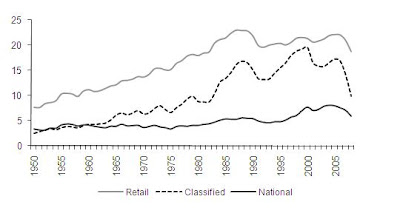 U.S. newspapers are in a mature industry with low growth potential once recovery from the recession occurs. Most companies will performance reasonably well after the recovery, but certainly some companies will have difficulties because of imprudent strategies and choices. Nevertheless, the industry as a whole will still remain in place producing revenue for many years to come.
Picard, R.G. (2001). Effects of Recessions on Advertising Expenditures: An Exploratory Study of Economic Downturns in Nine Developed Nations, Journal of Media Economics, 14(1): 1-14.
The developments must come as a surprise to those who saw the poor performance of recent quarters and convinced themselves that the newspaper industry is dead and gone.
Admittedly, the positive results in the past 3 months were achieved through restructuring, reducing news staffs to their 1970s levels, heavy cost cutting everywhere, and postponing reinvestments. But it shows there is still life in the industry and that the industry can be expected to recover in the coming year if economic conditions continue their current rate of improvement. As I have said many times, a industry with $50 billion in revenue is not going to ignore that revenue, close the doors, and disappear overnight.
Many have viewed the poor company performance in the past 2 years and then mistaken the steep concurrent drop in advertising as evidence of a general decline caused by long-term industry trends. In doing so, they have disregarded the impact of the economy on newspaper advertising and mistaken the dramatic drop in advertising as being an indicator of the industry's broader condition rather than the shorter-term results of 4 quarters of negative growth that have affected the economy as a whole. Some have also ignored the effects of corporate debt problems had on the industry's overall condition.
In multiple blogs and articles journalists and editors have pointed out that newspapers have fared worse than other media in the recession and used that the fact as evidence that the industry is a death's door. Two decades of research on newspapers during recessions, however, has shown newspapers typically fare worse because retail and classified advertising on which the industry relies are more affected by downturns than brand advertising (See post “The Credit Crisis, Volatile Markets, and Recession and Media” and the articles below). Obviously a lot of newspaper managers and journalists don't pay attention to research about their own business.
If one looks at the newspaper advertising expenditures over time (see Figure below), one sees that they fall with recessions and then recover. This pattern was especially evident from 1991 to 1993 and 2001-2003 when short downturns pushed newspapers into decline.
 If one considers different category of advertising, it is clear that the classified advertising—which was a driver of growth in the 1990s—was significantly troubled after 2000, but recovered and spiked in 2005 (Figure 2). Its relative decline by comparison to retail and national advertising is probably the result of some substitution with the Internet, nevertheless newspaper classifieds produced $10 billion in 2008—3 times that of online classified.
 U.S. newspapers are in a mature industry with low growth potential once recovery from the recession occurs. Most companies will performance reasonably well after the recovery, but certainly some companies will have difficulties because of imprudent strategies and choices. Nevertheless, the industry as a whole will still remain in place producing revenue for many years to come.
 It will do so because more than 45 million people are still willing to purchase a paper daily and retail advertisers still gain better results from newspaper advertising than from broadcast, Internet, and other forms of advertising.
Related Articles of Interest
Picard, R.G. & Rimmer, T. (1999). Weathering a Recession: Effects of Size and Diversification on Newspaper Companies, Journal of Media Economics, 23(4):21-33.
Picard, R.G. (2001). Effects of Recessions on Advertising Expenditures: An Exploratory Study of Economic Downturns in Nine Developed Nations, Journal of Media Economics, 14(1): 1-14.
Picard, R.G. (2008). “Shifts in Newspaper Advertising Expenditures and their Implications for the Future of Newspapers,” Journalism Studies, 9(5):704-716.
van der Wurff, R., Bakker, P. & Picard, R.G. (2008). Economic Growth and Advertising Expenditures in Different Media in Different Countries, Journal of Media Economics, 21:28-52.
ONLINE AGGREGATORS AND NEWSPAPER STRATEGY
Google, MSN, and Yahoo and other aggregators are cited by newspaper executives are harming newspapers. But what have they actually done? It is important to have a realistic understanding of their effects if one is to fashion strategies for the future of newspapers and news organizations.
Aggregators carry news stories from major news services and thus make international and national public affairs, entertainment and sports news widely available. The headline news on the aggregators’ home pages is becoming the primary news provider for those less interested in news and the online sections are well-used by news consumers who want more news or more timely news than appears in their daily newspaper.
Aggregators and others sites carrying content from news services are now contributing about 20 percent of the revenue of Associated Press, for example, taking some financial pressure off newspapers to fund the cooperative on their own. Other news services are also gaining income from online operators, thus helping them keep prices lower for newspapers as well.
So how do aggregators news harm newspapers? They harms papers to the extent that some less committed newspaper readers are willing to substitute their local paper with a news sources that don’t cover their cities. Some are willing to do so and this is taking some subscribers and single copy purchasers away from newspapers. U.S. newspapers have lost approximately 6 million circulation since 2000, but about half of that was circulation of the 70 competing newspapers or second editions papers that have been closed since the millennium. So one can thus say that at least 3 million people have decided to use other news sources.
Aggregators are also accused of STEALING value through their search functions and links to newspaper sites. Certainly the aggregators are CREATING value with the technique but are they taking value in violation of copyright or norms of content use? The answer is “no” because they do not represent the material as their own and direct those searching to the newspapers own sites, where they are exposed to advertising sold by the online newspapers.
Newspapers are now getting between 7-10 readers online for every reader they have in print. This plays an important role in making their sites attractive to advertisers, a development that generated the $3.2 billion in online advertising revenue that newspapers received in 2008.
Newspapers, of course, could stop the aggregators from linking to their content by putting it behind walls and charging for its use. If they did so, the aggregators could not link to it legally or technically without users encountering a pay or registration wall. So why haven’t newspapers done this until now? Frankly, because they get more readers and more advertising income by offering the material free.
Publishers are increasingly arguing that they should turn newspaper sites into paying sites and they have been holding joint discussion about how that might happen and whether it would be beneficial to do so simultaneously. This has raised some antitrust concern, but it raises real and significant questions of what such a strategy would accomplish.
In my estimation it is not as easy answer to the challenges newspapers face and has some elements that put its effectiveness in doubt. This is primarily because it is uncertain what existing readers will do. Will they subscribe to print AND online? Will they stay with print only? Or will they drop print?
The first option would be financially beneficial, but is likely to attract a limited number of readers unless the joint pricing is so attractive that it produces little new income for the newspaper firm. If that is the case the benefit of the strategy is reduced. The latter option would be very damaging to papers because print advertising creates more value than online advertising and prices for print ads would decline more than would be gained online.
It also needs to be recognized that people who do not currently buying newspapers are unlikely to buy subscriptions to online news sites. Thus, creating a paid model will likely reduce the boosted audience that free online news currently provides. This would have a negative effect on online audience and the increasing revenue that is being obtained from online advertising.
But what of heavy news users? As I have written in other entries in this blog, heavy users tend to be promiscuous and move between many online news sites. A commonly used system for micropayments would be necessary or these heavy users will reduce their use of multiple sites if each requires separate payment registration. Even with such a system in place, it is unlikely that more than 5-10 percent of the newspaper purchasing population would regularly use such a system.
Moving to a paid online model will not be as easy as agreeing that everyone should switch to paid on January 1 next year. It will require considerable strategic thinking and providing new types of value for consumers if it is to be successful. Even then, the benefits for newspapers will vary significantly depending upon the size, location, and competitive situation of individual newspapers.
Aggregators carry news stories from major news services and thus make international and national public affairs, entertainment and sports news widely available. The headline news on the aggregators’ home pages is becoming the primary news provider for those less interested in news and the online sections are well-used by news consumers who want more news or more timely news than appears in their daily newspaper.
Aggregators and others sites carrying content from news services are now contributing about 20 percent of the revenue of Associated Press, for example, taking some financial pressure off newspapers to fund the cooperative on their own. Other news services are also gaining income from online operators, thus helping them keep prices lower for newspapers as well.
So how do aggregators news harm newspapers? They harms papers to the extent that some less committed newspaper readers are willing to substitute their local paper with a news sources that don’t cover their cities. Some are willing to do so and this is taking some subscribers and single copy purchasers away from newspapers. U.S. newspapers have lost approximately 6 million circulation since 2000, but about half of that was circulation of the 70 competing newspapers or second editions papers that have been closed since the millennium. So one can thus say that at least 3 million people have decided to use other news sources.
Aggregators are also accused of STEALING value through their search functions and links to newspaper sites. Certainly the aggregators are CREATING value with the technique but are they taking value in violation of copyright or norms of content use? The answer is “no” because they do not represent the material as their own and direct those searching to the newspapers own sites, where they are exposed to advertising sold by the online newspapers.
Newspapers are now getting between 7-10 readers online for every reader they have in print. This plays an important role in making their sites attractive to advertisers, a development that generated the $3.2 billion in online advertising revenue that newspapers received in 2008.
Newspapers, of course, could stop the aggregators from linking to their content by putting it behind walls and charging for its use. If they did so, the aggregators could not link to it legally or technically without users encountering a pay or registration wall. So why haven’t newspapers done this until now? Frankly, because they get more readers and more advertising income by offering the material free.
Publishers are increasingly arguing that they should turn newspaper sites into paying sites and they have been holding joint discussion about how that might happen and whether it would be beneficial to do so simultaneously. This has raised some antitrust concern, but it raises real and significant questions of what such a strategy would accomplish.
In my estimation it is not as easy answer to the challenges newspapers face and has some elements that put its effectiveness in doubt. This is primarily because it is uncertain what existing readers will do. Will they subscribe to print AND online? Will they stay with print only? Or will they drop print?
The first option would be financially beneficial, but is likely to attract a limited number of readers unless the joint pricing is so attractive that it produces little new income for the newspaper firm. If that is the case the benefit of the strategy is reduced. The latter option would be very damaging to papers because print advertising creates more value than online advertising and prices for print ads would decline more than would be gained online.
It also needs to be recognized that people who do not currently buying newspapers are unlikely to buy subscriptions to online news sites. Thus, creating a paid model will likely reduce the boosted audience that free online news currently provides. This would have a negative effect on online audience and the increasing revenue that is being obtained from online advertising.
But what of heavy news users? As I have written in other entries in this blog, heavy users tend to be promiscuous and move between many online news sites. A commonly used system for micropayments would be necessary or these heavy users will reduce their use of multiple sites if each requires separate payment registration. Even with such a system in place, it is unlikely that more than 5-10 percent of the newspaper purchasing population would regularly use such a system.
Moving to a paid online model will not be as easy as agreeing that everyone should switch to paid on January 1 next year. It will require considerable strategic thinking and providing new types of value for consumers if it is to be successful. Even then, the benefits for newspapers will vary significantly depending upon the size, location, and competitive situation of individual newspapers.
The Challenges of Online News Micropayments and Subscriptions
The impetus toward subscriptions for access and micropayments for single use of online news is growing because online advertising alone cannot sustain the news organizations necessary to provide high quality and broad coverage.
In recent weeks Rupert Murdoch announced News Corp. will begin shifting its newspapers to an online paid model in the next 12 months, starting with Wall Street Journal and then progressively shifting papers such as the New York Post, The Times of London, the Sun and The Australian to a paid model. Dean Singleton followed by indicating MediaNews Group will begin doing the same for its papers, including Denver Post, San Jose Mercury News, Detroit News, St. Paul Pioneer Press, and Salt Lake city Tribune.
Clearly charging for online news is likely to reduce online consumption because of elasticity of demand, but—setting aside the extent to which demand for online news will fall if a price is imposed—moving to a paid model will also creates two common, industrywide challenges.
First, it forces each publisher to bear costs of setting up their own payment system. Secondly, it imposes a heavy burden on consumers. The latter burden results not from having to pay for news, but from the fact that online readers typically do not use only one online news source—unlike the market for print newspapers in which readers typically subscribe to only one paper.
It currently appears that each online newspaper or their corporate parent will set up their own payment systems. The options being most discussed are subscriptions for use or electronic wallets from which to make micropayments for occasional use.
These factors will have a particularly negative affect on the heaviest online news users—voracious and promiscuous readers who seek news from multiple news organizations. If each newspaper sets up its own payment system, for example, these readers will have to have separate payment accounts for the New York Times, Washington Post, Los Angeles Times, Wall Street Journal, The Guardian, and dozens of other publications they wish to visit.
To deal with this challenge the newspaper industry should seek to create a joint venture or cooperative to solve the problem. Companies should work together to developing a single system that is usable across sites and one that can be extended to handle payments for other types of online content. Such a system would simplify and encourage payment for content, but also develop a new revenue stream by turning the payment system from a cost center to profit center by charging companies for its use.
Free is clearly not the right price for news, but the movement to a paid model will not be as simple as transferring the existing subscription and single copy payment models for print newspapers to their online counterparts. Seeking payment online creates new challenges and opportunities that will require new thinking about how payments are made and more cooperation across the industry.
In recent weeks Rupert Murdoch announced News Corp. will begin shifting its newspapers to an online paid model in the next 12 months, starting with Wall Street Journal and then progressively shifting papers such as the New York Post, The Times of London, the Sun and The Australian to a paid model. Dean Singleton followed by indicating MediaNews Group will begin doing the same for its papers, including Denver Post, San Jose Mercury News, Detroit News, St. Paul Pioneer Press, and Salt Lake city Tribune.
Clearly charging for online news is likely to reduce online consumption because of elasticity of demand, but—setting aside the extent to which demand for online news will fall if a price is imposed—moving to a paid model will also creates two common, industrywide challenges.
First, it forces each publisher to bear costs of setting up their own payment system. Secondly, it imposes a heavy burden on consumers. The latter burden results not from having to pay for news, but from the fact that online readers typically do not use only one online news source—unlike the market for print newspapers in which readers typically subscribe to only one paper.
It currently appears that each online newspaper or their corporate parent will set up their own payment systems. The options being most discussed are subscriptions for use or electronic wallets from which to make micropayments for occasional use.
These factors will have a particularly negative affect on the heaviest online news users—voracious and promiscuous readers who seek news from multiple news organizations. If each newspaper sets up its own payment system, for example, these readers will have to have separate payment accounts for the New York Times, Washington Post, Los Angeles Times, Wall Street Journal, The Guardian, and dozens of other publications they wish to visit.
To deal with this challenge the newspaper industry should seek to create a joint venture or cooperative to solve the problem. Companies should work together to developing a single system that is usable across sites and one that can be extended to handle payments for other types of online content. Such a system would simplify and encourage payment for content, but also develop a new revenue stream by turning the payment system from a cost center to profit center by charging companies for its use.
Free is clearly not the right price for news, but the movement to a paid model will not be as simple as transferring the existing subscription and single copy payment models for print newspapers to their online counterparts. Seeking payment online creates new challenges and opportunities that will require new thinking about how payments are made and more cooperation across the industry.
Seeing through the Haze Surrounding Websites, Blogs and Social Media
Communicating regularly is hard work. It takes skill; it takes a voice; it takes having something to say; it takes time. Making money from it is even harder.
The functions provided by websites, blogs, and social media clearly make it possible for people to express themselves in ways never before imagined, to share their opinions, to express their hopes and dreams, and to share the details of their lives. Media companies are watching these developments and many are rushing to provide content on any communication technology or application the public uses.
Although large numbers of people are trying the new technologies, they are reacting to them in different ways. Some find them highly useful and satisfying; some find them worthless and disappointing; some find them a worthy pastime; others find them a waste of time. What this means is that—like all technologies—they are more important to some people than to others. Consequently, managers need to be realistic in assessing their potential, the extent to which they are being used by the public, and the extent to which they provide opportunities that media companies should pursue.
Because those promoting the technologies are self interested, uptake figures are easy to come by. Finding out who has tried the technologies, but decided they were undesirable is harder. However, research is showing some interesting results in that regard. We now know that 60 percent of the people who try Twitter stop using it within a month, that only about 5% of blogs are regularly updated, that more than 200 million blogs have been abandoned, and that about 37 million web domain names are deleted every year.
Most people and organizations who try these new communication opportunities make limited use of them or give up on them altogether because of boredom or because the opportunities don't provide sufficient results. This is not to say they are not unimportant, however. A good number of individuals and companies are using them to create new abilities and opportunities to communicate with friends, colleagues, and customers and to establish new businesses and revenue streams. Doing so, however, takes commitment that most people and firms are unwilling to make.
From the business standpoint one has to be realistic when evaluating the opportunities presented. Media executives need to ask hard questions: Do all media companies need to provide content across every available platform regardless of the cost and effort? Are all types of news and information appropriately carried on all platforms? In what ways is branding and marketing for the company actually served by these engagements? How are these monetized? What are the returns on the investments? What are the risks of not engaging these technologies?
Success is not easy in this technological environment. It requires investment, effort, regular activity, and provision of content that people want. Media managers choosing to use these new technologies must be clear-headed in their decisions and pursue well-founded strategies or they will be lost in the maze of competing and alternative opportunities.
The functions provided by websites, blogs, and social media clearly make it possible for people to express themselves in ways never before imagined, to share their opinions, to express their hopes and dreams, and to share the details of their lives. Media companies are watching these developments and many are rushing to provide content on any communication technology or application the public uses.
Although large numbers of people are trying the new technologies, they are reacting to them in different ways. Some find them highly useful and satisfying; some find them worthless and disappointing; some find them a worthy pastime; others find them a waste of time. What this means is that—like all technologies—they are more important to some people than to others. Consequently, managers need to be realistic in assessing their potential, the extent to which they are being used by the public, and the extent to which they provide opportunities that media companies should pursue.
Because those promoting the technologies are self interested, uptake figures are easy to come by. Finding out who has tried the technologies, but decided they were undesirable is harder. However, research is showing some interesting results in that regard. We now know that 60 percent of the people who try Twitter stop using it within a month, that only about 5% of blogs are regularly updated, that more than 200 million blogs have been abandoned, and that about 37 million web domain names are deleted every year.
Most people and organizations who try these new communication opportunities make limited use of them or give up on them altogether because of boredom or because the opportunities don't provide sufficient results. This is not to say they are not unimportant, however. A good number of individuals and companies are using them to create new abilities and opportunities to communicate with friends, colleagues, and customers and to establish new businesses and revenue streams. Doing so, however, takes commitment that most people and firms are unwilling to make.
From the business standpoint one has to be realistic when evaluating the opportunities presented. Media executives need to ask hard questions: Do all media companies need to provide content across every available platform regardless of the cost and effort? Are all types of news and information appropriately carried on all platforms? In what ways is branding and marketing for the company actually served by these engagements? How are these monetized? What are the returns on the investments? What are the risks of not engaging these technologies?
Success is not easy in this technological environment. It requires investment, effort, regular activity, and provision of content that people want. Media managers choosing to use these new technologies must be clear-headed in their decisions and pursue well-founded strategies or they will be lost in the maze of competing and alternative opportunities.
PERFORMANCE PROBLEMS SHAKE MYSPACE
The high hopes that News Corp. had for MySpace when it paid $580 million in for the social networking site in 2005 have never been realized and appear more elusive than ever.
Consequently, MySpace co-founders Chris DeWolfe (who is CEO) and Tom Anderson (who is President) are being pushed out of their management roles in major shakeup of the company's leadership.
The move is signals News Corp’s concern over the site’s declining market share and poor returns.
In the past three years Facebook has surpassed MySpace in total number of users worldwide, but MySpace has managed to remain the largest site in the U.S. and has 130 million users globally.
In 2008 the company had estimated advertising revues of $585 million, with the bulk coming from its ad-sharing deal with Google. But it will take a long, long time for News Corp. to recoup its investment at that pace. That revenue problem is compounded because Google has been unhappy with its MySpace deal and is unlikely to continue it at present terms when it expires next year.
The shakeup at MySpace underscores the value creation challenges that online media face. Services are typically offered free to generate high numbers of users and then these are used to create audiences for advertising or as a market for up-selling enhanced services. Although the audiences are attractive for some advertisers and some types of advertising, online advertising is not yet as effective as television and print advertising for most brands and retailers.
Consequently, MySpace co-founders Chris DeWolfe (who is CEO) and Tom Anderson (who is President) are being pushed out of their management roles in major shakeup of the company's leadership.
The move is signals News Corp’s concern over the site’s declining market share and poor returns.
In the past three years Facebook has surpassed MySpace in total number of users worldwide, but MySpace has managed to remain the largest site in the U.S. and has 130 million users globally.
In 2008 the company had estimated advertising revues of $585 million, with the bulk coming from its ad-sharing deal with Google. But it will take a long, long time for News Corp. to recoup its investment at that pace. That revenue problem is compounded because Google has been unhappy with its MySpace deal and is unlikely to continue it at present terms when it expires next year.
The shakeup at MySpace underscores the value creation challenges that online media face. Services are typically offered free to generate high numbers of users and then these are used to create audiences for advertising or as a market for up-selling enhanced services. Although the audiences are attractive for some advertisers and some types of advertising, online advertising is not yet as effective as television and print advertising for most brands and retailers.
DOES ONLINE NEWS STILL NEED OFFLINE TIES?
When the Seattle Post-Intelligencer ceased publication in mid-March it continued www.seattlepi.com as a web-only publication. It employs 20 persons, making it one of the largest online staffs of any local Internet news organization.
Although it has a much smaller staff than the print edition did, the site continues to cover local news and sports, provides national and international feeds, and features local bloggers. In many ways it is what many observers have called the future of post-print journalism. It is well recognized that print is an expensive way to convey news, information, and commentary so observers argue that the Internet is the answer for community informational needs because the public is increasingly getting their news there anyway.
It is still early days for forming a definitive view of how dropping print may affect online demand, but the P-I’s situation gives a unique opportunity to observe effects. In February—before the print edition closed—the website had 1.8 million unique visitors. In March, that number dropped to 1.4 million unique visitors. If these initial results hold true over time, it would indicate that print still provides some important reputational and marketing benefits to online activities.
Those interested in the online future of journalism should be watching the Seattle situation with interest in the coming year.
Although it has a much smaller staff than the print edition did, the site continues to cover local news and sports, provides national and international feeds, and features local bloggers. In many ways it is what many observers have called the future of post-print journalism. It is well recognized that print is an expensive way to convey news, information, and commentary so observers argue that the Internet is the answer for community informational needs because the public is increasingly getting their news there anyway.
It is still early days for forming a definitive view of how dropping print may affect online demand, but the P-I’s situation gives a unique opportunity to observe effects. In February—before the print edition closed—the website had 1.8 million unique visitors. In March, that number dropped to 1.4 million unique visitors. If these initial results hold true over time, it would indicate that print still provides some important reputational and marketing benefits to online activities.
Those interested in the online future of journalism should be watching the Seattle situation with interest in the coming year.
Why We Won't Pay for News
I recently forged my way the myriad of news reports on networks, papers, and web sites and discovered lots of attention-grabbing stories:
- Reuters had a story about the death of Mickey Rourke’ 18-year-old pet chihuahua.
- CBS News reported on cart that transforms into a sleeping tent for the homeless.
- Associated Press told me that Twitter was limiting message length and intending to start testing ways to make money.
- The New York Times informed me about people walking and running in stairwells as a means of keeping fit.
- CNN reported that Lance Armstrong’s stolen bicycle had been recovered.
- The Los Angeles Times reported on a city council candidate criticizing a rival for being defense attorney that represented a client who was accused of shooting a sea lion four years ago.
- ABC News carried a story on its website about efforts to produce cola containing cow urine in India.
- MSNBC reported that Starbucks is increasing the products its offers in offers as part of an effort to improve its performance.
Interesting? Yes. Significant? Hardly. Economically valuable enough to get people to pay for the news? Never.
Therein lies the problem. Most news organizations are still stuck in the get-the-attention-of-audiences, entertain-them-with-some-news-in-hopes-they-will-attend-to-serious-news-that advertisers-pay-for mode. They complain about declining audiences and use of news, but they are doing little to add value that makes it worth consumers paying for it themselves or spending time with it.
News as commodity; news for the masses; news that is fleeting; news that doesn’t provide significant intrinsic and extrinsic value will never induce readers, viewers, and listeners to pay for it. We are already paying what it is worth—little or nothing.
ASK DEEPER QUESTIONS ABOUT FINANCIAL CONDITIONS
Many observers tend to conceive any changes in media businesses as trends that are irreversible or to combine them with other changes to make sweeping generalizations about industry conditions. The results are often wrong and distract observers from asking deeper more appropriate questions about longer-term developments and how media companies use the resources they have.
To understand changes one needs to consider developments separately to determine their origin and expected duration. This allows one to determine what are the result of external trends and what are the result of company choices. Only then can one begin combining them with other observations.
Thus, one needs to consider whether the ratings increase for AMC is due to people spending more watching cable channels or an effect of the AMC's investments in quality programming and the popularity of programs such as Mad Men? If it is the former, one can enjoy benefits with little effort or extra investment; if it is the latter, the company will want to consider additional investments in other programming.
Is the decline in broadcast television advertising in the first half of 2008 a harbinger of a advertisers moving expenditures out of broadcasting or a reflection of the current economy and the condition of the automobile industry and its declining ad budget? If it is the first, long-term trouble is brewing and companies will need to give significant thought to their business models and cost structures. If it is the latter, the financial difficulties caused by the reduction may be short- to mid-term and will merely have to be endured until conditions improve.
Is the decline the in national newspaper advertising the result of reduced spending by advertisers or because of changes in the number of national advertisers and the ways they allocate their budgets. The latter requires rethinking income potential and expenditures for selling national advertising, whereas the former will create less longer-term trauma.
Many observers also seem to think that budgets cuts are necessarily bad and unusual for companies, but they are normal occurrences because of the cyclical nature of advertising expenditures. When ad dollars are flowing vigorously, media companies expand their budgets; when that flow lessens, companies reduce their budgets.
What is important about budget cuts is that they be instituted in strategic way to leave the core capabilities of the firm intact so the firm can benefit when conditions change and not miss critical time and financial benefits by having to rebuild those capabilities when better times occur.
It is alo important that budget cuts not be made equally and across the board, but that they be made by clearly analyzing the necessity of existing cost structures and operations. The challenge for many traditional media is that they are labor intensive and labor costs often are the one of the leading portions of their expenses. If one must cut labor, it should be done considering which employees can easily be replaced later, whether all operations, products, and services need to be maintained, and whether outsourcing some functions is an option.
Many companies also forget to look at the top as well as the bottom of their operations when cost cutting occurs. Today, for example, many newspaper companies need to be asking whether expensive corporate offices, private jets, and high corporate salaries and perks are warranted and necessary or if they should cut those corporate expenditures and the management fees they lay on local newspapers to pay for them.
In times of change, one needs clear vision of what is happening to an industry and company and to ask broader questions than are typically asked in firms and by industry observers. Those who do so benefit; those who don't pay a price.
To understand changes one needs to consider developments separately to determine their origin and expected duration. This allows one to determine what are the result of external trends and what are the result of company choices. Only then can one begin combining them with other observations.
Thus, one needs to consider whether the ratings increase for AMC is due to people spending more watching cable channels or an effect of the AMC's investments in quality programming and the popularity of programs such as Mad Men? If it is the former, one can enjoy benefits with little effort or extra investment; if it is the latter, the company will want to consider additional investments in other programming.
Is the decline in broadcast television advertising in the first half of 2008 a harbinger of a advertisers moving expenditures out of broadcasting or a reflection of the current economy and the condition of the automobile industry and its declining ad budget? If it is the first, long-term trouble is brewing and companies will need to give significant thought to their business models and cost structures. If it is the latter, the financial difficulties caused by the reduction may be short- to mid-term and will merely have to be endured until conditions improve.
Is the decline the in national newspaper advertising the result of reduced spending by advertisers or because of changes in the number of national advertisers and the ways they allocate their budgets. The latter requires rethinking income potential and expenditures for selling national advertising, whereas the former will create less longer-term trauma.
Many observers also seem to think that budgets cuts are necessarily bad and unusual for companies, but they are normal occurrences because of the cyclical nature of advertising expenditures. When ad dollars are flowing vigorously, media companies expand their budgets; when that flow lessens, companies reduce their budgets.
What is important about budget cuts is that they be instituted in strategic way to leave the core capabilities of the firm intact so the firm can benefit when conditions change and not miss critical time and financial benefits by having to rebuild those capabilities when better times occur.
It is alo important that budget cuts not be made equally and across the board, but that they be made by clearly analyzing the necessity of existing cost structures and operations. The challenge for many traditional media is that they are labor intensive and labor costs often are the one of the leading portions of their expenses. If one must cut labor, it should be done considering which employees can easily be replaced later, whether all operations, products, and services need to be maintained, and whether outsourcing some functions is an option.
Many companies also forget to look at the top as well as the bottom of their operations when cost cutting occurs. Today, for example, many newspaper companies need to be asking whether expensive corporate offices, private jets, and high corporate salaries and perks are warranted and necessary or if they should cut those corporate expenditures and the management fees they lay on local newspapers to pay for them.
In times of change, one needs clear vision of what is happening to an industry and company and to ask broader questions than are typically asked in firms and by industry observers. Those who do so benefit; those who don't pay a price.
DRIVERS OF CHANGE IN THE MEDIA ENVIRONMENT
Five decisive trends are driving changes in the media environment and forcing media companies to change their thinking and operations: media abundance, audience fragmentation and polarization, product portfolio development, the eroding strength of media companies, and a overall power shift in the communications process.
Abundance is seen in the dramatic rise in media types and units of media. The growth of media supply is far exceeding the growth of consumption in both temporal and monetary terms. The average number of pages in newspapers tripled in the twentieth century; the number of over-the-air television channels quadrupled since 1960s--supplemented by an average of about fifty-six cable channels in the average home; there are four times as many magazines available as in 1970s; 1.5 million new web pages are created daily, and created and stored knowledge (as measured by information scientists) is growing at a rate of 30 percent a year. We used to think of competition among newspapers or competition among television channels, but this media abundance has created competition not only among media but also competition between media and other leisure time activities such as sports, concerts, and socializing at cafes and bars.
The abundance has created fragmentation and polarization of the audience because people are spreading their media use across more channels, books, magazines, and websites. This produces extremes of use and nonuse among available channels and titles. In television, for example, there is a tendency for individuals to focus most use on three or four channels. Increasing channel availability does not create an equal amount of increased use. For example, if twenty channels are received in a household, the average viewed is five. When fifty channels are received, the average rises to twelve, and if one hundred channels are received, the average viewed by all members of the household is only sixteen. Advertisers understand this development and have responded by spreading their expenditures and paying less for smaller audiences. The audience-use changes mean that competition is no longer institutionally and structurally defined but is being defined by the time and money audiences/consumers spend with media, and the competitive focus is now on the attention economy and the experience economy.
The difficulties faced by individual units of media have led media companies to create and operate portfolios of media products. This response occurs because declining average return per unit makes owning a single media product problematic. The portfolios are efforts to reduce risk and obtain economies of scale and scope. These portfolios can increase return if they involve efficient operations and joint cost savings.
Despite the growth of portfolios and large media companies, the strength of the companies is eroding. Today no basic media content companies are in the top one hundred companies in the United States or in the top five hundred worldwide. Moreover, the reach of media companies is declining, even though they have grown bigger. Each has less of the viewers’, readers’, and listeners’ attention than in the past, and their difficult strategic position concerns many investors. As a result, media companies are struggling with their major investors, and all major media companies fear they may become takeover targets.
Underscoring all of this is a fundamental power shift in communications. The media space was previously controlled by media companies; today, however, consumers are gaining control of what has now become a demand rather than supply market. And media consumers are not merely content to be passive receivers any longer, many are now participating in production through the variety of forms of interactive and user generated content. This shift is apparent in the financing of contemporary initiatives in cable and satellite, TV and radio, audio and video downloading, digital television, and mobile media, which is based on a consumer payment model. Today, for every dollar spent on media worldwide by advertisers, consumers spend three. In the U.S., that ratin is 1 to 7.
Media companies worldwide are struggling to understand and adjust to wide-ranging external and internal changes that are altering modes of production, rapidly increasing competition, eroding their traditional audience and advertiser bases, altering established market dominance patterns, and changing the potential of the firms. The need for media managers to perceive, understand, and adjust to the new conditions increases daily because such changes can lead to failure of both existing and new products and, ultimately, lead to the loss of value or collapse of firms.
Abundance is seen in the dramatic rise in media types and units of media. The growth of media supply is far exceeding the growth of consumption in both temporal and monetary terms. The average number of pages in newspapers tripled in the twentieth century; the number of over-the-air television channels quadrupled since 1960s--supplemented by an average of about fifty-six cable channels in the average home; there are four times as many magazines available as in 1970s; 1.5 million new web pages are created daily, and created and stored knowledge (as measured by information scientists) is growing at a rate of 30 percent a year. We used to think of competition among newspapers or competition among television channels, but this media abundance has created competition not only among media but also competition between media and other leisure time activities such as sports, concerts, and socializing at cafes and bars.
The abundance has created fragmentation and polarization of the audience because people are spreading their media use across more channels, books, magazines, and websites. This produces extremes of use and nonuse among available channels and titles. In television, for example, there is a tendency for individuals to focus most use on three or four channels. Increasing channel availability does not create an equal amount of increased use. For example, if twenty channels are received in a household, the average viewed is five. When fifty channels are received, the average rises to twelve, and if one hundred channels are received, the average viewed by all members of the household is only sixteen. Advertisers understand this development and have responded by spreading their expenditures and paying less for smaller audiences. The audience-use changes mean that competition is no longer institutionally and structurally defined but is being defined by the time and money audiences/consumers spend with media, and the competitive focus is now on the attention economy and the experience economy.
The difficulties faced by individual units of media have led media companies to create and operate portfolios of media products. This response occurs because declining average return per unit makes owning a single media product problematic. The portfolios are efforts to reduce risk and obtain economies of scale and scope. These portfolios can increase return if they involve efficient operations and joint cost savings.
Despite the growth of portfolios and large media companies, the strength of the companies is eroding. Today no basic media content companies are in the top one hundred companies in the United States or in the top five hundred worldwide. Moreover, the reach of media companies is declining, even though they have grown bigger. Each has less of the viewers’, readers’, and listeners’ attention than in the past, and their difficult strategic position concerns many investors. As a result, media companies are struggling with their major investors, and all major media companies fear they may become takeover targets.
Underscoring all of this is a fundamental power shift in communications. The media space was previously controlled by media companies; today, however, consumers are gaining control of what has now become a demand rather than supply market. And media consumers are not merely content to be passive receivers any longer, many are now participating in production through the variety of forms of interactive and user generated content. This shift is apparent in the financing of contemporary initiatives in cable and satellite, TV and radio, audio and video downloading, digital television, and mobile media, which is based on a consumer payment model. Today, for every dollar spent on media worldwide by advertisers, consumers spend three. In the U.S., that ratin is 1 to 7.
Media companies worldwide are struggling to understand and adjust to wide-ranging external and internal changes that are altering modes of production, rapidly increasing competition, eroding their traditional audience and advertiser bases, altering established market dominance patterns, and changing the potential of the firms. The need for media managers to perceive, understand, and adjust to the new conditions increases daily because such changes can lead to failure of both existing and new products and, ultimately, lead to the loss of value or collapse of firms.
Subscribe to:
Posts (Atom)